China Manufacturing Hiring 2026: K-Shaped Crisis
China manufacturing is splitting: low-skill wages stagnant, 1.2M+ smart manufacturing talent shortage. Salary curves, 6 new roles, city dynamics, HR action plan.
China Manufacturing Talent Report 2026: K-Shaped Polarization and the New Hiring Playbook
Executive Summary: China's manufacturing sector is undergoing a structural transformation that has split its talent market into two sharply diverging trajectories. In the first half of 2026, industrial output above designated size grew by 5.4% year-on-year, while equipment manufacturing surged 9.3% and high-tech manufacturing soared 13.3% — the latter contributing nearly half of all industrial growth despite accounting for less than a quarter of total value-added output. Behind these headline numbers, however, lies a K-shaped curve tearing through the manufacturing talent market: low-skill positions are contracting with stagnant wages, while demand for high-skill composite talent has breached the 1.2-million-shortage mark, driving executive search fees to record highs. This report maps the full arc of that K-shaped curve and provides manufacturing HR leaders with a systematic framework for navigating it.
In 2025, China's industrial value-added reached RMB 41.7 trillion, contributing 35% to GDP growth. Manufacturing value-added alone stood at RMB 34.7 trillion, accounting for roughly 30% of the global total and securing the top position worldwide for the 16th consecutive year. But the story worth telling is not about scale — it is about the qualitative leap underway.
At the micro level, smart factories have moved from pilot showcases to operating standards. By mid-2026, China had built 35,000 foundational-level smart factories, 8,200 advanced-level facilities, and over 500 world-class intelligent plants. According to the Ministry of Industry and Information Technology (MIIT), the digital transformation coverage rate of industrial enterprises above designated size has climbed to 89.6%, with the equipment manufacturing sub-sector exceeding 92.3%.
The profit signal is equally telling. From January to May 2026, total profits of industrial enterprises above designated size grew 18.8% year-on-year, with equipment manufacturing profits up 21% and high-tech manufacturing profits surging 47.4%. Liang Yongmei, Associate Researcher at the Chinese Academy of Social Sciences' Institute of Industrial Economics, observed: "The dividends of industrial upgrading are now transmitting from the revenue side to the profit side. A virtuous innovation-profitability cycle has taken hold."
The "AI + Manufacturing" action plan, jointly issued by MIIT and seven other ministries, is now in full deployment. By 2027, China aims to deploy 3-5 general-purpose large language models in deep manufacturing applications, launch 1,000 high-level industrial AI agents, and roll out 500 benchmark use cases. This means that over the next 18 months, the talent requirements of manufacturing enterprises will undergo an even more profound structural overhaul.
From our executive search data serving manufacturing clients, one fundamental shift stands out: hiring budgets are migrating from "labor cost" line items to "technology investment" allocations. Three years ago, an HR director at a mid-sized factory spent her time managing blue-collar attrition rates and temp-agency fees. Today, she is negotiating offers for industrial robot commissioning engineers and building assessment frameworks for digital transformation project managers. This reclassification of what a "manufacturing hire" looks like means the traditional HR playbook no longer applies.
This is arguably the single most important picture in China's manufacturing talent landscape today — not a static number, but a set of dynamically diverging curves.
Data from Zhaopin's 2026 New Quality Productive Forces Talent Development Report paints a sobering picture: 87.7% of manufacturing general workers remain stuck in the RMB 4,500-8,000 monthly salary band. Fresh manufacturing graduates start at approximately RMB 5,300 per month — a figure that has barely moved in five years. Production line operators, manual quality inspectors, material handlers, and assembly line workers face a hard salary ceiling of RMB 8,000, compounded by the dual threat of replacement by younger workers after age 35 and displacement by automation.
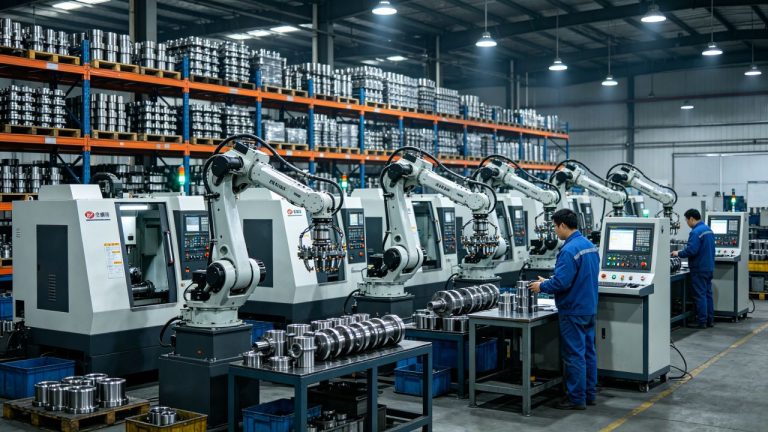
The Xiaomi Wuhan Smart Home Appliance Factory offers a telling case study: injection molding and sheet metal workshops achieving 100% automation, AI-powered visual inspection covering all critical components, and a production cadence of one air conditioner every 6.5 seconds. A production line that once required 30-40 workers now runs with 3-4 supervisors. Five traditional roles — injection molding operator, sheet metal operator, manual quality inspector, material handler, and assembly line worker — are systematically entering what can only be described as an "extinction channel."
In sharp contrast to the downward curve, high-end technical roles continue their relentless ascent. According to Liepin's Q1 2026 data, manufacturing positions posted through executive search channels increased 45.95% year-on-year, with complete vehicle manufacturing leading at 62.22% growth. The talent gap for composite roles in smart manufacturing has held persistently above 1.2 million, with positions in industrial control automation and multi-axis synchronous motion control seeing recruitment surges exceeding 45%.
The salary differential is even more striking: in the Yangtze River Delta, technicians proficient in PLC programming and servo system integration are commanding annual packages north of RMB 300,000. Senior-level five-axis/multi-axis CNC programming process engineers earn RMB 300,000-500,000, with executive search consultants permanently stationed on retainer. Composite smart manufacturing engineers — those who can integrate machining, automation, and information systems across the full value chain — operate in a market with no effective salary ceiling.
The essence of this K-shaped polarization is not a simple "high-skill versus low-skill" divide, but a wholesale redistribution of value across the manufacturing value chain. According to National Bureau of Statistics data, output of 3D printing equipment, lithium-ion batteries, and industrial robots grew 48.5%, 39.3%, and 28.0% respectively in H1 2026 — all high-value-added products that inherently demand high-skill workers. Meanwhile, the bio-based materials sector saw value-added growth of 26.3% as traditional chemical fiber companies redefined their value proposition through technological upgrading, concurrently forcing upward migration of workforce skills.
Among SunTzu China's manufacturing clients, we observe a concerning pattern: some mid-sized manufacturers are still recruiting with 2019-era salary structures and job descriptions. The result? Resume-to-application conversion rates for experienced technical talent have fallen below 3%. These companies' HR teams are not underperforming — they simply have not recognized that they are competing in an entirely different version of the manufacturing talent market. Our recommendation: recalibrate salary bands for core positions every 18 months, benchmarking not against "industry averages" but against the latest offer data from adjacent sectors you are actually competing with — new energy vehicles, semiconductor equipment, and smart hardware.
Industrial upgrading is rewriting the manufacturing job taxonomy. This quiet revolution operates in two simultaneous directions.
Injection molding and sheet metal workshop operators — robotic arms now perform precision operations in lights-out factories; manual quality inspectors — AI vision systems achieve detection accuracy of +/-0.05mm with 100% coverage of critical components and lower error rates than humans; material handlers — 4.2km overhead transport tracks and AGV driverless vehicles have become factory standards; assembly line workers — collaborative robots paired with flexible production lines are transforming assembly from "human-as-machine" to "human-commanding-machine"; basic data entry clerks — MES systems now capture production data in real time, automatically.
In their place, six fundamentally different roles are emerging, each requiring a capability profile distinct from anything traditionally found on a factory floor:
- Smart Equipment Maintenance Engineer: Requires PLC programming, servo parameter tuning, multi-axis synchronous logic control, and robotic arm diagnostics. Starting salary in the Yangtze River Delta: RMB 13,200/month; senior roles exceed RMB 25,000/month.
- Industrial Data Analyst: Operates industrial big data platforms, interprets OEE metrics, production cadence data, energy consumption curves, and other KPIs to drive process optimization. The composite manufacturing-IT background is the most sought-after and rarest profile.
- AI Algorithm Optimization Engineer: Proficient in machine learning and computer vision, responsible for industrial inspection model training, production scheduling optimization algorithms, and predictive maintenance model development. Salary range: RMB 250,000-500,000/year.
- Embedded Hardware-Software R&D Engineer: Must understand both MCU firmware at the driver level and application-layer logic. Develops core components such as smart sensors and edge computing gateways. Supply-demand ratio persistently above 1:3.
- Digital Twin Simulation Engineer: Uses digital twin platforms to conduct virtual commissioning and simulation validation of new production lines, compressing trial-production cycles. One of the fastest-growing new manufacturing roles in 2026.
- Senior Process Standardization Engineer: Converts decades of craft experience into standardized parameter libraries that enable autonomous machine optimization. This role bridges the gap between the "tacit knowledge of veteran craftsmen" and "machine-executable digital instructions."
Manufacturing HR leaders preparing next year's headcount plans should conduct a mandatory exercise: position-by-position automation displacement risk scoring. The metric is not "how many people currently fill this role" but "what percentage of this role's tasks are codifiable, repeatable actions that a machine can execute." For roles scoring above 60% displacement risk, the answer is not conventional recruitment — it is a structured transition program that retrains incumbents toward equipment maintenance and data analytics roles, rather than continuing to hire low-skill labor.
The geographic distribution of manufacturing talent is undergoing a deep reshuffling. Liepin big data shows that in the first week after the 2026 Chinese New Year, new manufacturing job postings in Wuhan (+110.28%), Hefei (+104.23%), and Suzhou (+103.74%) all exceeded 100% growth year-on-year. These cities are seizing the incremental manufacturing talent share that would historically have gravitated to traditional Tier-1 cities.
By salary tier and industrial profile, three distinct clusters have emerged:
| Tier | Representative Cities | Smart Mfg. Engineer Annual Salary | Core Industry Label | Talent Competition Intensity |
|---|---|---|---|---|
| Tier 1 | Shanghai, Shenzhen, Suzhou, Dongguan, Beijing | RMB 230K-380K | IC equipment, NEVs, industrial robots, high-end medical devices | Extreme (3-6 months per hire) |
| Tier 2 | Guangzhou, Ningbo, Foshan, Hangzhou, Changzhou | RMB 170K-300K | Smart home appliances, equipment manufacturing, auto parts, new materials | High (20-35% below Tier 1) |
| Tier 3 | Wuhan, Chengdu, Chongqing, Zhengzhou, Xi'an | RMB 110K-200K | Display panels, aerospace, rail transit equipment | Moderate (40-55% below Tier 1) |
Notably, Tier 1 itself is fragmenting. Shanghai, Shenzhen, and Beijing collectively account for 47.08% of high-end manufacturing positions, but net inflow growth is decelerating. Suzhou has leapfrogged to the national lead in advanced materials hiring — with a 67% position growth rate — driven by industrial clustering effects: the density of enterprises in nanomaterials, third-generation semiconductors, and high-performance fibers within Suzhou Industrial Park has created a self-reinforcing gravitational pull on materials science and engineering talent.
The critical variable for Tier 2 and Tier 3 cities is accelerating industrial migration. As leading manufacturers shift production capacity from Tier 1 cities to central and western China — driven by the combined calculus of energy costs, land costs, and labor costs — cities are developing distinct talent brand identities: Wuhan for optoelectronic information, Hefei for new energy vehicles and integrated circuits, Chengdu for aerospace. Each is building a talent reservoir with its own city-specific industrial label.
In SunTzu China's recent midwest manufacturing recruitment projects, we have observed a notable trend: salary offers from central and western manufacturers are closing the gap with Tier 1 cities, narrowing from a 50-60% differential five years ago to 25-40% today. The reason is straightforward: inland manufacturers have realized that "closer to home" and "lower cost of living" will not attract top-tier talent — they must offer cross-region competitive total compensation packages. For HR leaders, this means that salary benchmarking for Tier 2 and Tier 3 locations can no longer rely on "local market" data alone. The reference set must include Tier 1 cities in adjacent industries.
Based on the analysis above, manufacturing HR leaders should place the following six priorities at the top of their H2 2026 agenda:
- Complete a position-by-position automation displacement risk assessment. Calculate the "codifiable action ratio" for every production role. For positions scoring above 60% displacement risk, suspend routine hiring and redirect budgets toward reskilling programs. This is not a layoff exercise — it is the prerequisite for structural workforce optimization.
- Establish cross-industry salary benchmarking. Expand the compensation reference set from "same industry + same city" to "adjacent industries + talent-source cities." A Changzhou injection molding plant HR director should benchmark not only against Changzhou plastics industry data but also against the offers Suzhou NEV component companies and Wuxi medical device firms are making for equipment engineers — because these industries are competing for the same mechatronics graduates you need.
- Launch a campus "skill pre-deployment" program. Partner with 2-3 engineering universities to embed PLC programming, industrial robot commissioning, and MES operations training into the junior-year curriculum. The Ministry of Human Resources has planned 10 million subsidized vocational training slots for 2026 — manufacturing enterprises should proactively channel their talent requirements into this policy pipeline.
- Build a "veteran craftsman-to-digital" knowledge translation system. The tacit process knowledge of retiring veteran workers is a manufacturing enterprise's most valuable intangible asset. Establish a SOP digitization workshop to convert their experiential wisdom into standardized parameter libraries that machines can execute. This is a 2-3 year patient-capital project — but the window is narrowing.
- Design dual-track acquisition and development pathways for hardware-software composite talent. Engineers fluent in both algorithmic software and hardware fundamentals are the rarest species in the entire market. In the short term, executive search precision headhunting is the primary channel (external acquisition); in the medium term, establish cross-functional rotation mechanisms for internal engineers (internal cultivation), with particular emphasis on cross-pollinating IT and manufacturing engineering departments.
- Redefine your employer value proposition. When "work at a factory" is no longer a default career option for young graduates, manufacturing enterprises must build an attraction system that transcends salary alone. Concrete elements include: a clearly mapped "operator-to-technician-to-engineer-to-project-manager" career ladder, opportunities to participate in building smart production lines from scratch, and comprehensive coverage of digital transformation certification programs.
Of the six priorities, we recommend making Priority 5 (composite talent acquisition and development) your lead initiative. Two reasons: first, embodied intelligence sector job postings surged 215.8% year-on-year in 2026 (Liepin data), creating an outflow of hardware-software talent from that adjacent domain; second, the supply side for hardware-software composite talent is growing far slower than demand, meaning that first-mover advantage, once established, is extremely difficult for competitors to close within 12 months. SunTzu China maintains dedicated talent pools across PLC automation, industrial robotics, MES/SCADA systems architecture, and smart manufacturing project management — and offers targeted executive search and talent mapping services for manufacturing enterprises.
Smart Manufacturing | High-End Equipment | Automotive & Components | Advanced Materials | New Energy
For the complete data appendix to this report or to schedule a manufacturing talent mapping consultation, contact SunTzu China Industry Research Center
www.suntzhchina.com