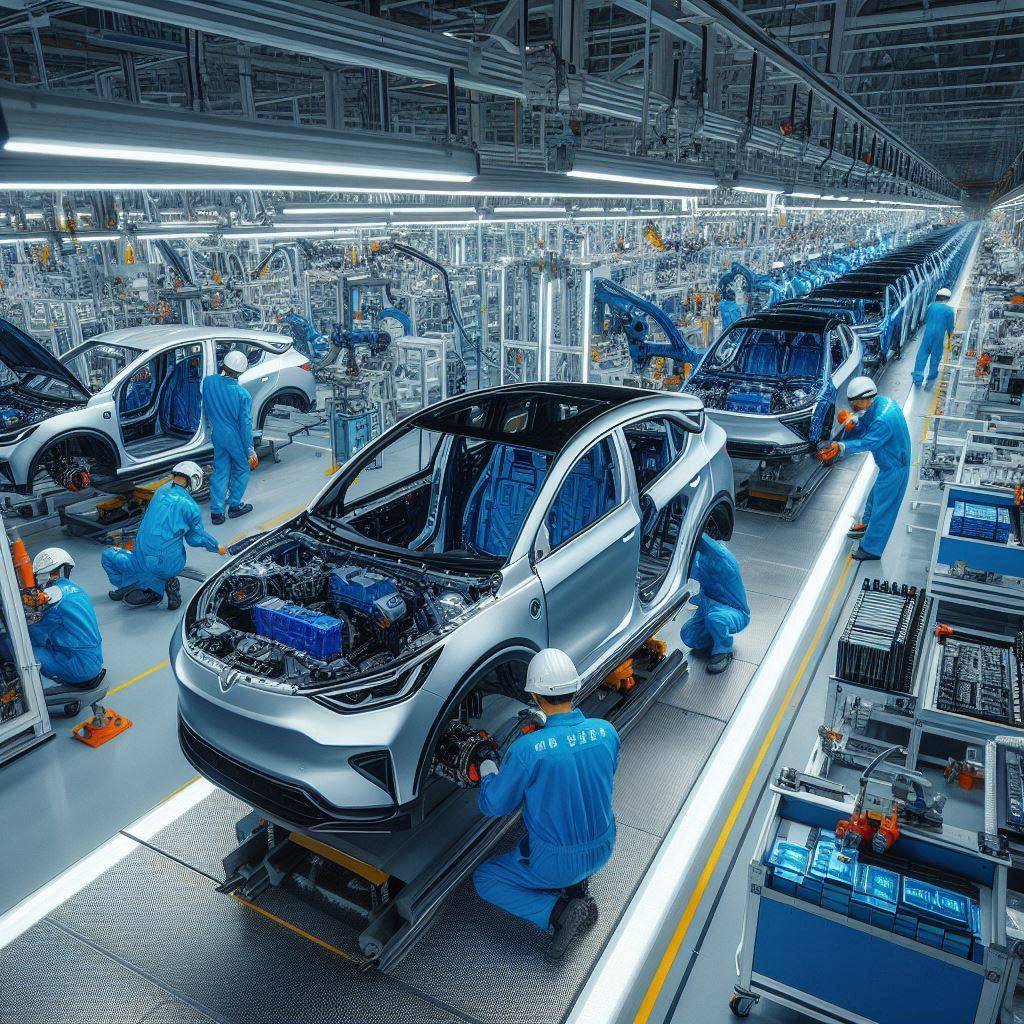
Chinese NEV exporters face a unique compensation challenge: designing a system that incentivizes overseas relocation without breaking domestic pay equity.
3.1 Overseas Assignment Compensation Build
The total package for overseas assignees typically consists of four layers:
“`
Total Package = Domestic Benchmark × Premium Multiplier + Regional Allowance + Housing/Education/Travel Benefits + One-time Relocation Fee
“`
3.2 Overseas Premium by Tier
Employee Tier | Domestic Premium | Typical Roles | Typical Total Package |
Junior/Entry-level | 1.5-2x | Tech support, after-sales engineer | ¥300K-600K |
Mid-level / Tech Expert | 1.4-1.6x | Product mgr, regional tech lead, plant ops | ¥700K-1.3M |
Senior Tech Expert | 1.5-1.8x | AD overseas deployment lead, BMS applications | ¥1.2M-1.8M |
Executive / Regional GM | 1.8-2.2x | Regional GM, overseas R&D center head | ¥2M-5M+ |
3.3 Regional Monthly Allowance Comparison
Assessment: Europe commands the highest allowances — not just because of higher living costs, but because Chinese NEVs in Europe need “brand premium talent” who can tell the brand story to European customers and media in English or German. The difficulty and cost of hiring this hybrid talent far exceeds factory management personnel.
—
IV. Talent Flow Landscape (2020-2025)
Three waves define the talent flow pattern in China’s NEV industry.
4.1 Three Waves of Talent Migration
4.2 Key Talent Battles
XPeng → NVIDIA: The most dramatic team-level poaching
At least 6 XPeng autonomous driving executives joined NVIDIA within 12 months — from VP of autonomous driving Wu Xintong to heads of perception, sensor fusion, and software architecture. NVIDIA’s compensation premium (P90 ¥1.8M-2.5M vs XPeng’s ¥1.2M-1.5M for comparable roles) made this a one-way street.
Baidu: The “Whampoa Military Academy” of autonomous driving
Baidu’s autonomous driving division has seeded talent across nearly every major Chinese NEV player: Li Auto’s VP of intelligent driving, BYD’s autonomous driving team leader, Haomo.AI’s CEO, Geely’s chief intelligent driving engineer — all Baidu alumni.
The Reverse Flow
Since 2024, a new pattern has emerged: traditional OEM talent moving into NEV companies. Volvo’s autonomous driving director joined BYD, Changan’s deputy chief engineer joined NIO, Bosch China’s R&D director joined Li Auto. This signals that traditional automotive engineering management experience is becoming more valuable as NEV companies shift from product-driven startup mode to global operations-driven scale mode.
4.3 Autonomous Driving Team Sizes
—
V. The Four Biggest Hiring Challenges for NEV Exporters
Challenge 1: Expat vs. Local — Who to Hire for What?
Most Chinese NEV exporters follow a “2+2” strategy: core management and key technical roles are Chinese expatriates; sales, after-sales, and plant operations are locally hired. But this model faces pressure — the EU requires local production content, Indonesia demands 50%+ localization by 2027. BYD’s Brazil factory has created 20,000 local jobs, but the typical “Chinese manager trains local successor” cycle takes 2-3 years.
Challenge 2: Managing the Dual-Track Pay System
A Chinese expatriate plant quality manager’s total package may be 40-60% higher than a Brazilian local counterpart at the same grade. Beyond fairness concerns, this creates an inherent divide within overseas teams. Some companies are experimenting with “localization-based pay decoupling”: after 2-3 years on assignment, expatriates convert to local employment contracts at local market rates, retaining only a small differential allowance.
Challenge 3: Where to Find Hybrid Talent?
The most scarce talent is not single-skill — it’s “technical + language + cross-cultural management” combined. Engineers who understand autonomous driving typically don’t speak German; overseas sales managers who speak English can’t interpret technical parameters. Some companies have started internal cultivation: sending technical high-potentials on 1-2 year overseas rotations with language training and cross-cultural management courses.
Challenge 4: Cross-Border Enforcement of Non-Compete Clauses
Chinese non-compete clauses are enforceable in Chinese courts but effectively void overseas — especially in Europe. An overseas business director who moves from BYD to NIO faces no legal constraint under European law. This exposes NEV exporters to higher IP and trade secret leakage risk abroad. Mitigation strategies include “staged information disclosure” (critical business decisions revealed in phases) and “extended equity vesting” (option/restricted stock vesting stretched to 4-5 years).
—
VI. Practical Implications for HR
If You Are an HR Leader at a Chinese NEV Exporter
- Build a dual-track compensation system differentiating domestic and overseas roles
Benchmark domestic tech roles against the midpoint between foreign Tier 1 suppliers (Bosch/Continental/Aptiv) and Chinese tech giants (Huawei/Baidu). Benchmark overseas assignee packages at the 75th percentile of comparable Chinese expatriate roles in each market. Build a 3-year transition mechanism guiding employees from “expatriate status” to “local employee status.”
- Don’t compete for AD talent on pay alone — offer “technical impact” narrative
Why could NVIDIA poach XPeng’s entire AD team? It wasn’t just money — the technical influence of a global AI platform on top algorithm engineers far outweighs an in-house OEM project. If your compensation package can’t beat NVIDIA, differentiate on “technical autonomy,” “how your overseas market defines the product,” and “publication/patent output mechanisms.”
- Start overseas talent pipeline development now, not when the factory is built
From signing the overseas plant agreement to production launch typically takes 18-24 months. But recruiting, training, language preparation, and family relocation for the management team takes at least 6-9 months. Following this timeline, a Hungary plant launching in late 2025 required core hires locked in by early 2024. Most companies’ mistake is starting recruitment 3 months before launch — then discovering that qualified candidates won’t relocate, and relocatable candidates lack the qualifications.
If You Are an Overseas HR Professional Tracking Chinese Competitors
- Chinese NEV exporters’ impact on your business is in the European talent market, not the product market
Chinese NEV companies are hiring aggressively across Europe — NIO has built a multi-hundred-person team in 8 countries, XPeng has an R&D center in Munich. They are hiring not just Chinese nationals but also local European talent and overseas Chinese engineers. This will push up compensation for Chinese/English bilingual technical talent across European automotive. If your European operations depend on Mandarin-speaking engineers or sales staff, budget for a 15-30% increase in 2026.
—
VII. Trends to Watch: 2026-2028
Trend 1: Overseas R&D Centers Upgrading from “Satellites” to “Hubs”
BYD’s Hungary R&D center, NIO’s Oxford/Silicon Valley labs, XPeng’s Munich R&D office — these are evolving from “localization adaptation” to “frontier technology development.” Overseas roles will shift from “application-oriented” to “research-oriented,” and compensation for overseas R&D heads will converge with global tech company benchmarks.
Trend 2: “Overseas Talent” Will Become an Independent Compensation Benchmark Category
When an NEV company is hiring simultaneously in Hungary, Brazil, and Indonesia, its compensation system is no longer an “extension” of the China market — it becomes an independent global compensation architecture. By 2027, leading Chinese NEV exporters will likely adopt Mercer/Aon’s global job grading systems rather than domestic Chinese grading.
Trend 3: The Competition Shifts from “Talent War in China” to “Organizational Capability on a Global Battlefield”
The competitive moat in Phase 3.0 of overseas expansion is not a single product or technology — it is whether a company can efficiently deploy, develop, and retain technical talent across ten countries, five languages, and three legal systems. This demands a fundamental organizational shift — from “a Chinese company sending someone overseas” to “a global company with an R&D center in China.”
—
Data Notes
 Data Nature: All compensation figures are industry trend estimates, not precise survey data. Actual compensation varies significantly by company size, individual capability, and market conditions.
Scope: Annual total compensation (cash salary, performance bonus, option/equity valuation), pre-tax RMB. Period: Q1 2026.
Reference Sources:
- – BYD 2025 annual report, Leapmotor overseas business filings, XPeng global strategy disclosure
- – MIIT “Manufacturing Talent Development Plan” talent gap data
- – Sina Finance “China Autonomous Driving Talent Flow” in-depth report
- – East Money, 36Kr, Gasgoo Auto, China Daily public reporting
- – Industry executive search internal compensation benchmarking data (Sun Tzu China aggregated)
Disclaimer: Compensation figures are estimates and should not be used as direct basis for compensation decisions. Actual figures may differ materially from the estimates presented.