
Telecom Industry “5G Surplus, 6G Shortage”
China Mobile and China Telecom's 2026 campus recruitment offers six insurances plus two housing funds with transparent compensation, yet traditional network optimization engineers face a supply-demand ratio of 2.3:1; 6G R&D investment exceeds 30 billion yuan with patent applications accounting for 40.3% globally, but faces the "mismatch paradox" of 120,000 network optimization position gaps and scarce 6G algorithm talent—the telecom industry is experiencing a painful transformation from "infrastructure dividend" to "technology dividend."

In January 2026, MIIT data showed: 5G base station total reached 4.758 million, 5G users surpassed 1.184 billion, with penetration rate exceeding 60%.
Meanwhile, China Academy of Information and Communications Technology (CAICT) predicts that by 2030, China’s 6G market size will reach 1.3 trillion yuan, forming a trillion-level industry and application market.
This is an extremely divided industry landscape.
On one side, 5G construction peak has passed, traditional network optimization engineer positions are shrinking, and position growth at equipment vendors like Huawei/ZTE is slowing; on the other, 6G R&D has launched, with 300 key technology reserves including terahertz communication/intelligent reconfigurable surfaces, and three major operators each investing billions in deployment.
When “5G+Industrial Internet” projects exceed 20,000 yet remain at basic connectivity stages, when traditional telecom talent faces “ceiling effects” while 6G algorithm engineers earning ¥420,000 annually still can’t be recruited, this dual transformation from “network deployment” to “application development,” from “5G construction” to “6G R&D,” is rewriting the career destinies of 2 million telecom professionals.
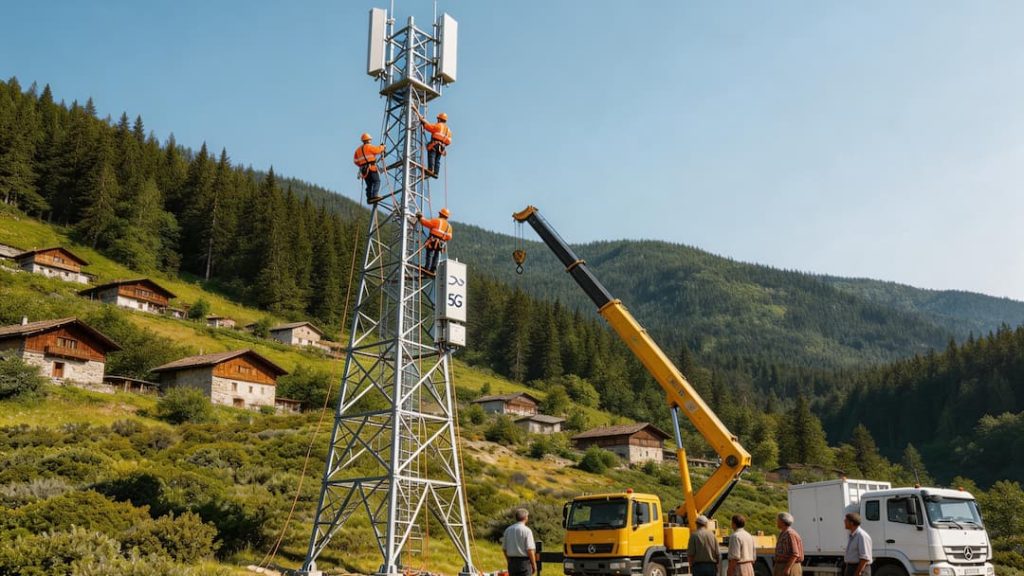
5G "Construction Dividend" Fading: Traditional Positions Hit Ceiling
As of December 2025, China’s 5G base station total reached 4.758 million, covering over 300 cities nationwide, with cumulative 5G mobile phone users surpassing 1.184 billion, maintaining global leadership in penetration rate for years. Behind these numbers lies the turning point of 5G construction from “peak period” to “maintenance period.”
Base Station Construction Peak Passed: 2020-2023 was the “golden three years” of 5G base station construction, with average annual additions exceeding 1 million stations. But by 2024-2025, the growth rate noticeably slowed, shifting from “deployment” to “optimization.” This means demand for network engineers and base station construction engineers—traditional “iron army” positions—has plummeted.
Traditional Position Supply-Demand Imbalance: In 2025, network optimization engineer position gap reached 120,000, yet the supply side shows “structural surplus”—many network optimization engineers from the 4G era cannot directly migrate their skills to 5G, much less adapt to 6G R&D requirements. The supply-demand ratio reached 2.3:1, meaning 2.3 job seekers compete for 1 position in the market.
An HR from a telecom service company revealed: “We offered ¥300,000 annual salary for 5G network optimization positions and received 500 resumes in half a year, but fewer than 20 truly qualified. Many only know how to adjust 4G parameters, unfamiliar with 5G’s Massive MIMO, network slicing, SA/NSA networking, let alone AI algorithms.”
Equipment Vendors “Growth Slowing”: Huawei, ZTE and other equipment vendors recruited heavily during 5G construction peak, but as the market saturated, position growth noticeably slowed. Huawei’s 2026 campus recruitment for communication algorithm engineer positions only increased 8% year-over-year (compared to 45% in 2023), and ZTE’s campus recruitment scale also stabilized. Traditional telecom equipment vendor position growth slowing, need to shift toward high value-added fields.
Salary Growth Stagnant: For master’s graduates in Information and Communication Engineering from University of Electronic Science and Technology of China (UESTC), starting salaries at equipment vendors dropped from ¥280,000 in 2020 to around ¥250,000 in 2026. Operator technical position salaries are even more “stable”—stable in the ¥150,000-250,000 range for years without change. An engineer working at a provincial telecom for 3 years complained: “Annual salary rose from ¥180,000 to ¥210,000, 5% increase each year, but inflation far exceeds wage growth. My classmate in internet already earns ¥400,000+.”
Career Development “Ceiling”: Traditional telecom position promotion paths are relatively rigid: field engineer → network architect → technical expert. But reaching the technical expert level often requires 10+ years of accumulation, with extremely limited positions available. Many find their career development stagnating after 5-7 years of work.
Direct headhunting is therefore essential. This involves:
Identifying target companies and competitor organizations
Mapping key leadership roles within those companies
Approaching candidates confidentially and professionally
Building long-term relationships rather than rushing into a quick pitch
For senior candidates, trust matters more than job details in the initial stage. A discreet and respected approach increases both response rate and long-term engagement.
6G R&D Launch: New Track Generates New Demand
While 5G construction cools, 6G R&D has already launched at full speed, becoming the telecom industry’s “second growth curve.”
Policy-Level Top Design: The “15th Five-Year Plan” lists sixth-generation mobile communication as a key future industry layout direction, with MIIT clearly defining key tasks including deepening standard development and building test networks. By the end of 2025, China has reserved over 300 6G key technologies, covering core directions like terahertz communication, intelligent reconfigurable surfaces, and air interface AI.
Global Leader in Patent Applications: As of June 2025, China’s 6G patent applications account for approximately 40.3% globally, ranking first worldwide. Contributed 38% technical papers in 3GPP R18/R19 standards, leading key technology projects like integrated sensing and communication, passive IoT, forming a complete system from international standards to industry specifications to testing certification.
30 Billion Yuan Industrial Fund Support: Three major operators each have focus areas—China Mobile advancing integrated communication-computing-intelligence, integrated communication-sensing technology pilots; China Telecom focusing on semantic communication, satellite-direct-to-mobile directions; China Unicom conducting on-orbit testing through “Unicom Constellation” low-orbit satellites. Industry-academia-research collaborative innovation system has gradually improved.
Market Size Expectations: According to CAICT predictions, by 2030, China’s 6G market size will reach 1.3 trillion yuan, forming a trillion-level industry and application market. This scale is equivalent to creating a “new telecom industry.”
Emerging Position Demand Surges:
- 6G Algorithm Engineer: Responsible for cutting-edge algorithm R&D in terahertz communication, intelligent reconfigurable surfaces, air interface AI integration. Median annual salary ¥420,000, some leading companies can reach ¥500,000+. But market gap reaches 80,000.
- Integrated Sensing and Communication Engineer: Realizes communication and sensing integration, applied in low-altitude traffic, intelligent driving scenarios. China Mobile’s integrated sensing and communication technology achieves kilometer-level small target detection, but related talent is extremely scarce.
- Semantic Communication Specialist: China Telecom’s key layout direction, requires cross-border talent who understand both communication protocols and natural language processing. Annual salary ¥350,000-500,000.
- Satellite Communication Engineer: China Unicom’s “Unicom Constellation,” China Telecom’s direct satellite service covering tens of millions of terminals, but space communication engineers become “new profession.” Annual salary ¥300,000-450,000.
- Cloud Computing Solution Architect: Telecom operators accelerate transformation to cloud services, requiring talent who simultaneously master network architecture design, distributed computing and AI integration capabilities. According to IDC reports, 2025 cloud computing talent gap reached 500,000, senior architects easily exceed ¥500,000 annual salary.

"Mismatch Paradox": 5G Talent Surplus, 6G Talent Shortage
The greatest dilemma currently facing the telecom industry is the structural mismatch of “5G talent surplus” and “6G talent shortage.”
Skills Cannot Migrate: 5G network optimization engineers master engineering skills like Massive MIMO parameter adjustment and network slicing configuration, but 6G requires research capabilities like terahertz algorithms, intelligent reconfigurable surface modeling, AI and air interface integration. Between these two skill sets exists a huge “chasm.”
A 5G engineer working at a telecom company for 8 years confessed: “I can use Huawei U2020 for network optimization, but asking me to do 6G terahertz channel modeling, I have no idea where to start. The company says there’s transfer training, but training content is all deep learning, Python, TensorFlow—feels like going back to university.”
Academic Threshold Rising: Traditional 5G positions can be filled with bachelor’s degree + Huawei HCIP certification. But 6G R&D positions universally require master’s or above, with doctoral degree holders preferred. 6G positions at Huawei’s 2012 Labs and ZTE Research Institute uniformly require “PhD + top-tier conference publications.”
Cross-Disciplinary Barriers: 6G is not merely telecom technology iteration, but fusion of multiple disciplines including communication, AI, sensing, computing. Traditional communication major graduates often lack cross-border capabilities in AI algorithms, big data analysis, cloud computing.
A PhD advisor in Communication Engineering at UESTC lamented: “Students we cultivate have solid communication theory foundations, but asking them to do AI and air interface integration shows limitations. Conversely, computer science students understand AI but don’t understand communication protocols. Truly cross-disciplinary talent is too scarce.”
High Enterprise Training Costs: For enterprises to cultivate a 5G engineer into 6G R&D talent requires at least 2-3 years and hundreds of thousands in training costs. But many enterprises worry about “train and jump ship,” unwilling to invest.
Salary Inversion: 5G network optimization engineers earn ¥250,000-300,000 annually, 6G algorithm engineers start at ¥420,000, salary gap as high as 40%-60%. This inversion causes many 5G talents to want transformation but lack capability; 6G positions can’t recruit despite high salaries because too few meet requirements.
For foreign or multinational companies, it is essential to evaluate:
The candidate’s leadership style and team management approach
Communication skills across different cultural environments
Ability to navigate complexity, ambiguity, and rapid change
Alignment with corporate values and long-term business strategy
Top candidates are also evaluating you at the same time. They are asking whether your company understands the Chinese market, respects local talent, and is prepared to invest in long-term success.
A strong cultural and strategic fit is what ultimately determines whether an executive will thrive, not just accept the role.

Application Dilemma: 20,000 “5G+Industrial Internet” Projects Still at Basic Connectivity Stage
Although 5G base station construction is in full swing, application-level “deep water zone” has not truly opened.
“5G Showroom” to “Scale Replication” Chasm: As of 2025, cumulative “5G+Industrial Internet” construction projects exceeded 20,000, applications penetrated 86 of 97 major categories in national economy classification. Sounds promising, but reality is: some vertical industries’ 5G applications still remain at basic connectivity stages, insufficient deep integration with core production processes, difficult to form scalable replication solutions.
Single Business Model: Traditional pipeline charging model difficult to sustain, user ARPU value growth weak, operators caught in dilemma of traffic dividend ceiling and rising operating costs. 5G’s value not fully converted to industrial returns.
Low SME Penetration: Lack of unified cross-industry standards leads to low 5G penetration in small and medium enterprises, restricting expansion and upgrading of entire industrial ecosystem. An industrial internet solution provider revealed: “Large enterprises willing to invest in 5G, but SMEs think 4G is sufficient, unwilling to pay for 5G.”
Application Talent Scarcity: 5G applications require not only people who understand communication but also those who understand industries. For example, “5G+Healthcare” requires hybrid talent who understand both 5G technology and medical processes; “5G+Smart Manufacturing” requires people who understand both 5G and industrial automation. This type of “Telecom+X” cross-border talent is extremely scarce in the market.
China Unicom focuses on promoting application implementation across 700,000+ key scenarios. The 5G-A flexible trial production line co-built with automotive manufacturers compressed production line adjustment time by 90%. But such success cases are extremely difficult to replicate, with key bottleneck being lack of hybrid talent who understand industry + telecom.
Talent Strategy: From “Skills Training” to “Cross-Border Integration”
Facing the dilemma of “5G surplus, 6G shortage,” Suntzu China headhunter Team recommend leading enterprises are exploring new talent strategies:
Internal Transfer Training
Huawei, ZTE and other equipment vendors launched “5G→6G” transfer training programs. Huawei internally established “6G Experimental Class,” selecting outstanding 5G engineers for 1-year intensive training, covering: terahertz communication, deep learning, Python programming, TensorFlow framework, etc. Those completing training and passing assessments can transfer to 6G R&D departments with 30%-50% salary increases.
ZTE cooperates with universities to provide on-the-job master’s/doctoral degree programs for employees, encouraging engineers to “work while furthering education.”
“Telecom+X” Hybrid Cultivation
Three major operators launched “Industry Expert” certification systems. For example, China Mobile’s “5G+Healthcare Expert” certification requires not only understanding 5G technology but also familiarity with medical industry processes, medical equipment interfaces, medical data security, etc. Certified individuals can serve as “5G+Healthcare” project managers, annual salary ¥350,000-450,000.
China Telecom launched “5G+Industrial Internet” dual certification cultivation: on one hand obtaining Huawei HCIE communication certification, on the other hand obtaining Industrial Internet Engineer certification. Dual-certified talent enjoys 20%-30% salary premium.
Industry-Education Integration Targeted Cultivation
BUPT, UESTC, Southeast University and other communication powerhouse universities co-build “6G Joint Laboratories” with Huawei, ZTE. Students can participate in 6G projects during school, entering enterprise 6G departments directly after graduation.
Shanghai Jiao Tong University’s AI Academy offers “Embodied Intelligence” courses for master’s and doctoral students, with teaching content including embodied intelligence perception, cognition, prediction, decision-making, simulation, world models, etc., cultivating “AI+Telecom” hybrid talent.
External Recruitment of AI Talent
Due to deep integration of 6G and AI, some telecom enterprises begin recruiting AI talent from internet giants. Huawei’s 2026 campus recruitment explicitly states it welcomes computer science and AI major graduates to apply for “6G Air Interface AI Algorithm Engineer” positions, with starting salaries matching or exceeding communication majors.
But this “cross-border talent recruitment” also faces challenges: AI talent doesn’t understand communication protocols, requiring lengthy “catch-up”; while telecom talent doesn’t understand AI algorithms, similarly needing “re-training.”
Flexible Employment and Project-Based Systems
Some 6G R&D projects adopt “project-based + flexible employment” models. Enterprises no longer recruit full-time employees but hire experts from universities and research institutes according to project needs, paying per project. This model reduces enterprises’ labor costs while giving researchers greater flexibility.