BYD's CFO Hits $1.4M Salary — And a 40-Million-Person Talent War Begins
BYD's CFO Zhou Yalin saw her salary jump from $185K to $1.4M in one year — the first A-share auto executive to break the 10-million-yuan barrier. Behind it: 4,000 factory workers hired, R&D raises, and a $415K overseas role left unfilled for two years. China's NEV talent war is rewriting manufacturing compensation.

BYD CFO Zhou Yalin saw her salary jump from $185K to $1.4M in one year.
Zhou Yalin has worked at BYD for 26 years.
In 2024, her annual salary was 1.34 million yuan ($185,000). In 2025, it hit 10.13 million yuan ($1.4 million). An 8x increase in 11 years. She became the first CFO of an A-share listed automaker to break the 10-million-yuan barrier.
The news hit the headhunting circles like a shockwave. Not because the number itself was shocking — internet company CFOs make much more. The shock was that BYD is an automaker. The salary ceiling of the entire automotive industry had just been kicked through by a company based in Shenzhen.
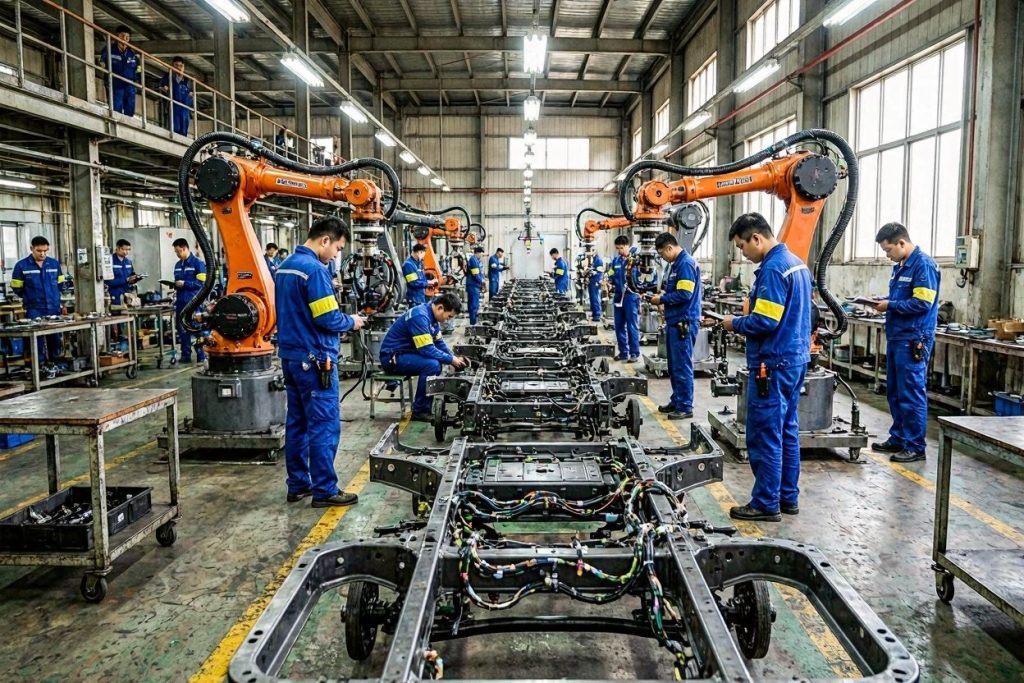
But if you read this as just another story about executive compensation, you’re missing the real signal. While Zhou was getting her raise, BYD was also doing the following: hiring 4,000 factory workers in its spring recruitment drive, offering skilled workers monthly salaries exceeding 10,000 yuan; giving across-the-board raises to R&D staff, with increases of up to 4,500 yuan per person.
This isn’t one company being generous. It’s a structural shift hitting an industry that employs over 40 million people in China.

Three Levels of Battle
The NEV talent war is playing out on three fronts simultaneously, each with completely different rules.
The frontline: factory workers.
BYD hiring 4,000+ workers at over 10,000 yuan per month sounds reasonable for Shenzhen. But in manufacturing, it’s a signal. Factory line workers in China have historically earned between 4,000 and 6,000 yuan per month. The jump to 10,000 means manufacturing is now competing directly with food delivery platforms — Beijing delivery riders also average over 10,000 yuan per month, per recent spring recruitment data. If factories don’t match the price, they don’t even get an interview.
Recruiters at Sun Tzu China experienced this firsthand with an auto parts supplier in Jiangsu. The factory offered 6,500 yuan base plus overtime — above local average. Three months later, positions were still unfilled. The HR director’s explanation was blunt: “Everyone’s delivering food. Who still works in a factory?”
The middle: engineers.
The talent gap for battery, motor, and electronic control systems engineers is the widest in the entire industry. An R&D director at a battery company told me they offered a researcher specializing in electrolyte chemistry 800,000 yuan per year. The candidate asked for three days to think about it — not because the money wasn’t good, but because he was simultaneously negotiating with three other companies.
BYD’s R&D raises are just one snapshot of this broader war. When a car company’s CFO can hit 10 million yuan, you understand where the engineers’ leverage comes from. It’s not that their bosses are generous. It’s that if they don’t pay up, the engineer will be interviewing at NIO tomorrow.
The top: overseas leadership.
A recent 36Kr report revealed a stark case: an NEV company has been searching for an overseas market director for two years. The offered salary: 3 million yuan ($415,000) per year. The position remains unfilled.
Two years. Three million yuan is top-tier compensation in any industry. The problem is that the pool of qualified candidates nationwide is probably under 50 people. They need to understand automotive, know overseas markets, handle local compliance and channel development, and be willing to relocate abroad. Cross those four filters, and the pool goes to zero.
The Industry-Wide Reshuffling
The BYD story isn’t isolated. Across the NEV ecosystem in 2025-2026:
SK Hynix announced 2026 employee bonuses could exceed 3 million yuan per person. Li Auto’s CEO Li Xiang topped the Hong Kong stock compensation chart at 639 million yuan. Headhunter quotes for NIO, Xpeng, and Li Auto positions rose 30-50% year-over-year. The entire NEV supply chain — from lithium mining to batteries to vehicles to charging infrastructure — is competing for talent.
Meanwhile, traditional automakers are telling a different story. Joint venture factories are cutting headcount. Combustion engine engineers face retraining pressure. Talent flows from legacy auto to NEV are accelerating, and the direction is one-way.
UBS data from March 2026 shows China’s NEV penetration rate has exceeded 50%. Overseas expansion is just beginning. When a Chinese automaker decides to build a factory in Europe, open distribution in Southeast Asia, or find partners in the Middle East, it needs an entire cross-functional team. That team needs to be pulled from a domestic talent pool that’s already stretched thin.
Simple math: China now holds over 60% of the global NEV market. For every percentage point of overseas market share gained, thousands of new positions open. Every new position drives the next round of bidding.
Two Questions for Every HR Leader
This salary surge presents two genuinely hard questions.
How do you distribute? The classic dilemma: you hire a new engineer at 30% above your existing team’s salary. When the old team finds out, do you match or not? Many NEV companies now operate with “inverted” compensation structures — new hires’ market rates already exceed internal veterans’ pay. This isn’t bad HR. It’s a structural distortion inherent in a hyper-growth industry. One non-negotiable rule: don’t let any critical role’s compensation sit in an outdated benchmarking system. Recalibrate salary bands quarterly, not annually.
When does it stop? The uncomfortable answer: it won’t stop soon. As Chinese NEV companies expand globally — building factories in Europe, networks in Southeast Asia, partnerships in the Middle East — demand for talent will only intensify. Every new market means a new team. Every new team means more hiring and higher offers.
——————————————————————————————
Zhou Yalin’s journey from 1.34 million to 10.13 million yuan over 26 years is a story about persistence. But it’s also a story about being in the right industry at the right time.
If you were a combustion engine engineer in 2019, your salary curve was flat. If you switched to NEV the same year, it may have doubled or tripled. Same person, same capability, same effort — three times the value. Not because of individual merit, but because the industry cycle was pricing you differently.
When a company selling 4 million vehicles per year starts raising salaries across the board, it doesn’t just affect its own employees. It pulls the entire supply chain, the entire industry, and potentially the entire manufacturing sector’s compensation coordinates upward with it.
The question for HR is no longer “to raise or not to raise.” It’s “how to raise — and whether you’ve taken your seat at the table before the price moves again.”