Anode Graphitization Gap in China: Hiring Cost | SunTzu China
China added 650,000 t of integrated anode capacity in September while graphitization toll fees passed RMB 10,000/t. Pay bands, supply and time to hire.
Data as of September 30, 2026
One. Graphitization, not finishing, is the binding constraint, and it is a structural mismatch rather than a shortage of capacity overall. Broker research puts synthetic graphite finishing capacity at 4.5m to 5.0m tonnes against 4.2m to 4.6m tonnes of supporting graphitization capacity, with the latter persistently behind the former. Longzhong data puts effective anode capacity at 5.52m tonnes, first-half output at 1.95m tonnes, utilisation at 73% and the leading producers running flat out. Capacity as a whole is not tight. What is tight is the capacity that can clear the graphitization step.
Two. The toll fee reset is rewriting cost structures and pushing outsourcing above 30%. The graphitization processing fee started the year around RMB 8,000 per tonne and has moved past RMB 10,000 on some orders, a gain of more than 25%. Producers without enough in-house graphitization are being pushed past 30% outsourced, taking the pressure into delivery schedules and gross margin at the same time.
Three. Capital intensity is pushing competition toward scale and cheap power. Integrated projects generally cost more than RMB 12,000 per tonne of annual capacity. Two listed producers announced 650,000 tonnes of new integrated anode capacity in September alone; including a 300,000-tonne project disclosed in late August, roughly 950,000 tonnes has surfaced in a little over a month. All of it is sited for tariffs, and all of it pays for that choice with a shallow local labour pool.
Four. The talent gap concentrates in a handful of roles, and geography prices them more than skill does. Furnace loading and unloading operators at Yunnan Shanshan are posted at RMB 7,000 to 8,000 a month on a 12-hour rotating shift in dust and heat; line operators and production reserve cadres at BTR's Jiangsu base at RMB 8,500 to 11,000; Shanshan's Sichuan plant lists an on-site graphitization technician at RMB 5,000 to 7,000 with a chemistry or materials degree and two years of experience. The same process step can cost nearly twice as much in one province as another.
1. Finding: 650,000 tonnes in a single month, and the money goes into graphitization
September 2026 produced enough anode expansion announcements to require tracking them by week. On 21 September, Keda Manufacturing disclosed plans to invest roughly RMB 4.5 billion in a 500,000 t/y integrated graphite anode project in Tumd Right Banner, Baotou, in Inner Mongolia. The company currently runs 150,000 t/y of anode capacity, rising to 180,000 t/y once 2026 upgrades complete, so the new project is more than triple its existing base.
A day later, Shanshan announced RMB 5.106 billion for a 150,000 t integrated lithium battery anode project, of which RMB 4.318 billion is fixed-asset investment, with 50,000 t of graphitization capacity explicitly earmarked alongside it. The build runs 17 months, with groundbreaking in March 2027 and completion in July 2028. Shanshan's first-half figures came with the announcement: revenue of RMB 12.13 billion, up 23.04%, and net profit attributable to shareholders of RMB 822 million, up 296.73%. In July, control of the company passed to the Anhui provincial state assets regulator.
A week or so earlier, on 25 August, Zhongke Electric disclosed a fundraising plan of up to RMB 2.4 billion, of which RMB 1.8 billion goes to its 300,000 t Sichuan Zhongke Xingcheng project, which carries roughly RMB 7 billion of total investment. Separately, Xuetian Salt said it would acquire 100% of Kuntian New Energy in a share-and-cash transaction, crossing over from salt chemicals into anode materials.
Taking September alone, two listed producers announced 650,000 t of new integrated capacity; adding Zhongke Electric brings the figure to about 950,000 t over a little more than a month. The detail worth pausing on sits inside Shanshan's filing: the company listed "50,000 t of supporting graphitization capacity" as a separate line item. That is not boilerplate. It signals that graphitization has stopped being an internal process step and become something that gets applied for, funded and built on its own.
| Date | Company | Project | Scale and investment |
|---|---|---|---|
| 21 Sep 2026 | Keda Manufacturing | Integrated graphite anode project, Tumd Right Banner, Baotou, Inner Mongolia | About RMB 4.5 billion, planned 500,000 t/y; current capacity 150,000 t/y, rising to 180,000 t/y after upgrades |
| 22 Sep 2026 | Shanshan | 150,000 t integrated lithium battery anode project with supporting graphitization | RMB 5.106 billion total, RMB 4.318 billion fixed assets; 50,000 t supporting graphitization; 17-month build, March 2027 to July 2028 |
| 25 Aug 2026 | Zhongke Electric | Funding for the 300,000 t Sichuan Zhongke Xingcheng anode project | Raising up to RMB 2.4 billion, RMB 1.8 billion to this project; project total investment roughly RMB 7 billion |
| September 2026 | Xuetian Salt | Acquisition of 100% of Kuntian New Energy | Share and cash consideration; entry into anode materials from salt chemicals |
| Aggregate | — | 650,000 t announced in September; about 950,000 t including Zhongke Electric | Sum of announced project scales; excludes upgrades where no scale was disclosed |
2. Attribution: three variables behind the gap
GGII data puts China's lithium battery shipments at 1.21 TWh in the first half of 2026, with 2.75 TWh forecast for the full year and 3.3 TWh in 2027. On SNE Research numbers, global energy storage battery shipments reached 461.3 GWh in the first half, up 71%, while traction battery installations reached 608.5 GWh, up 20.0%. Storage is growing faster than traction, and a storage cell consumes no less graphite anode material per unit than a traction cell.
At company level, Shangtai Technology shipped about 199,000 t of anode in the first half, up 41%, and described conditions publicly as demand running ahead of supply with outsourcing covering the difference. One leading producer's shipment growth and its reliance on toll processors describe the shape of this gap precisely: demand has not overshot forecasts, one link in the chain has not kept pace.
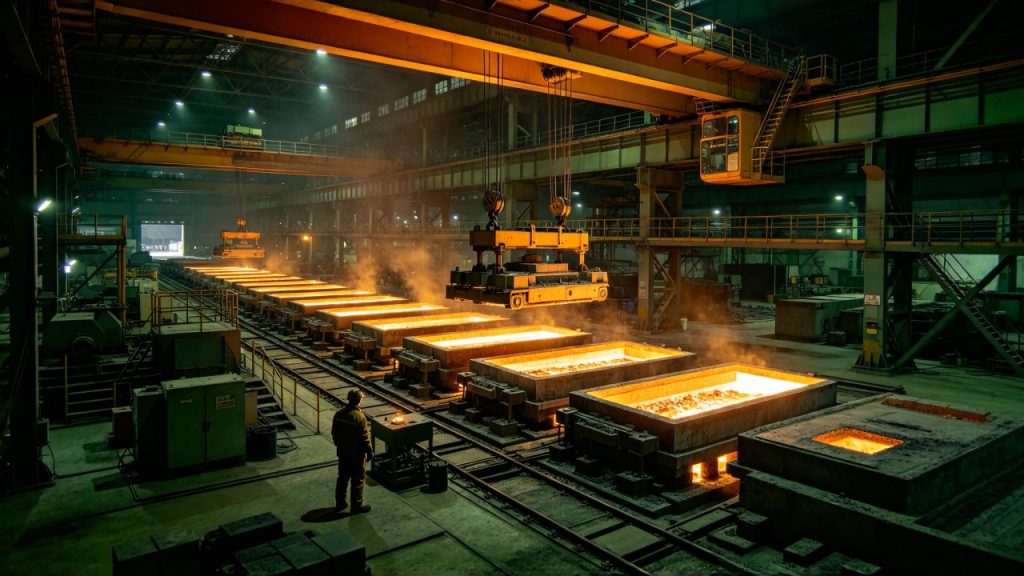
Anode splits into natural and synthetic graphite, and synthetic accounts for more than 80% of shipments. Within the synthetic route, graphitization cannot be skipped. Carbon stock is held above 2,000 degrees Celsius so that disordered carbon rearranges into an ordered graphite lattice, which sets the finished product's specific capacity, first-cycle efficiency and cycle life. It is also the most energy-hungry, longest-cycle and slowest-to-build step in the chain.
Broker research draws the comparison plainly: 4.5m to 5.0m tonnes of synthetic graphite finishing capacity against 4.2m to 4.6m tonnes of supporting graphitization. Longzhong puts effective anode capacity at 5.52m tonnes, first-half output at 1.95m tonnes and utilisation at 73%, with leading producers sold out and running flat out. Read together, the two sets say total capacity is not tight — utilisation is barely above 70% — but capacity that can complete graphitization is. The few hundred thousand tonnes between the finishing lines and the graphitization lines is the hole this round of expansion exists to fill.
Integrated projects generally run above RMB 12,000 per tonne of annual capacity, which is what turns a per-tonne unit cost into investment figures of RMB 7 billion, RMB 4.5 billion and RMB 5.1 billion. Because graphitization is electricity-intensive, tariffs and power quotas largely decide whether a project works at all. That is why new capacity clusters in Yunnan, Sichuan and Inner Mongolia: Shanshan's Yunnan base carries RMB 12 billion of total investment, plans 300,000 t across six process steps and targets RMB 15 billion of annual output value at full run, and the Sichuan and Baotou projects follow the same siting logic.
The catch is that siting optimises for electricity. Recruiting then pays a premium for a shallow labour pool. The three regions share one profile: a clear energy cost advantage, a limited stock of experienced local process workers, and neighbouring industries such as solar-grade polysilicon and electrolytic aluminium competing for the same people who have run high-temperature furnaces.
3. Mechanism: how a processing fee reaches the hiring plan
A toll fee moving from about RMB 8,000 to above RMB 10,000 per tonne looks like a line item in a cost model. It travels a long way before it lands on a recruitment schedule. The path runs like this: toll fees rise, so outsourcing stops being cheap, so integrated producers accelerate their own graphitization builds to protect margin; an integrated project takes around 17 months; and a line that must fire on schedule needs its people in place six to nine months ahead of commissioning to be trained. The hiring window therefore opens a year before commissioning, and it opens against every anode base already operating in the region.
Working conditions compound the difficulty. The core roles on a graphitization line are tied to high-temperature furnaces. Furnace loading and unloading operators charge and discharge the graphitization furnaces, overhead crane operators move loads inside the hall, forklift drivers handle material flow, and on-site technicians watch furnace condition and process parameters. Yunnan Shanshan's posting states it plainly: must accept dust and high temperature, four days on and two off, 12-hour rotating shifts. Roles under those conditions recruit within a radius of a few dozen kilometres. Cross-province hiring holds badly, because workers weigh commuting and local amenities rather than headline pay.
That explains what is most often missed in anode material recruitment: the first large anode project in a region captures the local labour dividend, and the second and third have to buy talent away at a higher price. With million-tonne-scale projects planned across Yunnan, Sichuan and Inner Mongolia at the same time, that dividend is being divided several ways. For new energy materials talent, furnace operating experience accumulates over years, and capital expenditure cannot compress the training time.
One further competitive layer tends to be overlooked. The skills involved transfer more easily across industries than within one. Workers with high-temperature furnace experience are equally useful in solar-grade polysilicon, electrolytic aluminium and carbon products. What anode producers are really competing for is the shared pool of furnace hands across every energy-intensive industry in the region, not only the people already inside batteries.
Graphitization roles are priced differently from ordinary manufacturing roles. Three variables set the number: process difficulty, since furnace loading and crane operation are critical and hard to substitute; environmental compensation, since dust, heat and rotating shifts need pricing separately; and regional cost, since low-tariff regions are usually low-wage regions too. Companies optimise electricity when they pick a site, then pay a premium for the thinness of the labour pool when they hire. For HR setting pay for these roles, the benchmark should not be the provincial manufacturing average but the same process role at an anode base already running nearby, and those two numbers routinely differ by more than 30%. Listing the environmental allowance separately from consolidated monthly pay also does more to control the expectation gap after joining than folding it into headline pay.
4. Talent: job structure and pay benchmarks in graphitization
Publicly visible postings give a reasonably clean pay cross-section for this step. At Yunnan Shanshan, furnace loading and unloading operators are listed at RMB 7,000 to 8,000 a month on a four-on, two-off 12-hour rotating shift, explicitly conditioned on accepting dust and high temperature; forklift drivers at RMB 5,500 to 7,500 with a licence required; and overhead crane operators, eleven positions, with no pay disclosed. At BTR's Jiangsu base, line operators and first-line production reserve cadres are both posted at RMB 8,500 to 11,000, laboratory testers at RMB 7,500 to 9,000 and junior reserve cadres at RMB 6,000 to 8,500. Shanshan's Sichuan plant is recruiting an on-site graphitization technician at RMB 5,000 to 7,000, requiring a chemistry, materials or electrochemistry background plus two years of relevant experience.
Set those side by side and something counter-intuitive appears: the Sichuan graphitization technician post pays less than the Yunnan furnace operator post. On grade, a technician role should sit above an operator role. It does not, and that is not an inverted grade structure — it is region pricing overriding skill pricing. Jiangsu has a higher manufacturing wage base and more competition for people, so an operator post there reaches RMB 11,000. Sichuan and Yunnan have lower local wage bases and many projects building at once, so even a technician role requiring two years of experience tops out at RMB 7,000.
How anode salary China should be designed follows directly: graphitization roles need regional banding, because a single group-wide salary band is too high for low-tariff regions and too low to hire in high-wage ones. A workable structure splits pay into three layers. The first is a local manufacturing base rate that moves by province. The second is a process allowance that prices furnace loading and crane work separately as hard-to-substitute roles. The third is an environmental allowance that itemises dust, heat and night shifts. Once the three are separated, pay translation for cross-region transfers has a basis.
| Company / site | Role | Monthly pay | Shift and requirements |
|---|---|---|---|
| Yunnan Shanshan (Yunnan, 300,000 t integrated site) | Furnace loading and unloading operator | RMB 7,000 to 8,000 | Four days on, two off, 12-hour rotating shifts; must accept dust and high temperature |
| Yunnan Shanshan | Forklift driver | RMB 5,500 to 7,500 | Forklift licence required; material transfer |
| Yunnan Shanshan | Overhead crane operator | Not disclosed | Eleven positions; in-hall lifting |
| BTR (Jiangsu) | Line operator | RMB 8,500 to 11,000 | Production line operations at an integrated base |
| BTR (Jiangsu) | First-line production reserve cadre | RMB 8,500 to 11,000 | Reserve cadre with a development track |
| BTR (Jiangsu) | Laboratory tester | RMB 7,500 to 9,000 | Materials testing and analysis |
| BTR (Jiangsu) | Reserve cadre | RMB 6,000 to 8,500 | Graduate and junior level |
| Shanshan Sichuan | On-site graphitization technician | RMB 5,000 to 7,000 | Chemistry, materials or electrochemistry; two years or more of experience |
5. Risk: four hurdles to price in early
6. Market benchmarks and conclusion
Translated into benchmarks a company can use directly, the numbers are these. On pay, key operating roles on a graphitization line cluster around RMB 6,000 to 9,000 a month at the midpoint: furnace loading and unloading at RMB 7,000 to 8,000, forklift drivers at RMB 5,500 to 7,500, and operators plus production reserve cadres at the Jiangsu base at RMB 8,500 to 11,000. On-site technical roles sit at RMB 5,000 to 7,000, below the operator roles because of regional differences rather than grade inversion.
On time to hire, integrated bases typically take about 17 months to build and recruitment generally starts six to nine months before commissioning. Working back from Shanshan's schedule, a project completing in July 2028 opens its hiring window in the second half of 2027, earlier still if neighbouring projects commission into the same window. On supply, one province alone — Yunnan — has 300,000 t of integrated anode capacity in planning, with comparable volumes building in Sichuan and Inner Mongolia, and the regional stock of experienced furnace hands is being spread thin.
On who is competing, the answer is not only battery producers. The skills involved transfer across industries more easily than within one, so solar-grade polysilicon, electrolytic aluminium and carbon product makers in the same regions chase the same workers, and that layer sets the effective floor under pay. If you want to know where the pressure shows first, ask where graphitization furnace operators come from.
On cost movement, the toll fee has gone from about RMB 8,000 to above RMB 10,000 per tonne, a gain of more than 25%. For producers with their own graphitization, that is an internal transfer. For those relying on toll processors, it comes straight out of margin along with the room to raise pay.
It is easy to write this expansion cycle up as a capacity arms race. What actually gates delivery is a single process step, and what gates that step is people and power. Capital can put a line up in 17 months; it cannot produce operators able to run a graphitization furnace unaided in the same time. For companies mid-cycle, moving workforce supply modelling forward into site selection, building pay as regional base plus process allowance plus environmental allowance, and opening the hiring window a year ahead of commissioning matter at least as much as securing a power tariff. For anyone in battery supply chain recruitment, that also sharpens the test of whether an anode project reaches nameplate: read past the capacity plan to the graphitization ratio, then ask whether battery recruiter China pipelines can actually fill those seats in that province.
Source tiering. Tier A covers listed-company announcements and periodic filings from Keda Manufacturing, Shanshan, Zhongke Electric and Xuetian Salt, and published industry research from GGII, SNE Research and Longzhong Information. Tier B covers first-hand financial media reporting and official corporate recruitment channels. This report does not use estimates from consultancies, training providers or self-media, nor salary surveys published by competing recruitment firms.
Capacity definitions. Synthetic graphite finishing capacity, supporting graphitization capacity and toll fee ranges are broker research figures and use a different basis from Longzhong's effective capacity series, so the two are cited side by side rather than summed or converted. The September figure of 650,000 t adds announced project scales directly and excludes technology upgrades for which no scale was disclosed.
Pay definitions. Monthly pay figures are consolidated ranges as posted by employers and recruitment channels, including base salary, shift premiums and environmental allowances; take-home varies with attendance, shift allocation and performance. Cross-region comparisons should account for differences in local wage base and competition for labour.
Modelling note. Growth rates, gaps and banding ratios quoted here are straight-line calculations from public data or common market practice, not forecasts of any company's actual investment, labour budget or hiring plan.
Currency and timeliness. RMB figures are as reported; where a USD equivalent is given it uses approximately USD 1 = RMB 7.1. Data is as of September 30, 2026. Project schedules, capacity plans, toll fees and pay ranges remain subject to later company announcements.
SunTzu China provides battery supply chain recruitment across anode and cathode materials, electrolyte, separator, cell manufacturing and energy storage systems, alongside executive search and mid-to-senior hiring in semiconductors, robotics, new energy vehicles, healthcare, cross-border e-commerce and IT and telecoms. The team also supports bulk line recruitment for new materials bases, pay benchmarking for process roles and cross-region redeployment planning. For regional pay benchmarks and supply assessments covering graphitization, carbon and high-temperature furnace roles, get in touch.