High Reward Packages: Samsung Invests Heavily in AI Talent Acquisition
Samsung chip workers get bonuses up to $416,000—8x salary. AI boom rewrites talent pricing. What does this mean for Chinese firms competing for engineers?
On May 27, Samsung Electronics reached an agreement with its labor union that will reshape global semiconductor compensation. The company will set aside 10.5% of its semiconductor division’s operating profit as a special bonus pool for chip workers. For a typical memory chip employee with a base salary of $53,400 (80 million won), the expected bonus this year is $416,000 (626 million won) — nearly eight times base pay. Bloomberg estimates the average bonus across Samsung’s 78,000 semiconductor employees at $340,000.
These numbers would be absurd in any manufacturing sector. But the real story is not the magnitude of the bonuses. It is what they reveal about a fundamental shift in how talent is priced in the AI era.
When AI chip demand pushes SK Hynix and Micron past $1 trillion in market capitalization, when UBS triples its Micron price target in a single day, and when a company defines its bonus pool by “10.5% of operating profit” — talent pricing has shifted from supply-and-demand to capital market expectations. The participants in this game have no exit. Samsung’s deal ended a five-month labor dispute that threatened an 18-day strike. For a company that accounts for roughly a quarter of South Korea’s exports, any shutdown could trigger a global supply chain crisis. Samsung’s choice was never “whether to pay” but “how much to keep people.”
Chinese semiconductor companies see their reflection, but the glass is cracked.
Chinese memory chip makers CXMT and YMTC have made real technology breakthroughs — CXMT’s DDR5 yield rates reached global mainstream levels in 2025, and YMTC’s 232-layer 3D NAND achieved volume production in specific categories. Technology barriers are dissolving. Talent barriers are rising.
The gap between Samsung and Chinese chip companies is not just about process nodes. A DRAM engineer at Samsung can receive $340,000 in annual bonus. A comparable engineer at a Chinese chip company earns a total package of 600,000 to 1.2 million RMB ($80,000 to $160,000). The gap is not 2x or 3x. It is 4x to 5x. When a bonus can cover a down payment on an apartment in Shenzhen, compensation stops being just pay — it becomes the pricing anchor for an entire industry.
A case handled by Sun Tzu China illustrates the problem. In late 2025, a Shanghai AI chip design company tried to recruit a DRAM architect from Samsung’s Korea headquarters. The candidate’s condition was simple: match his Korean package ($420,000). The Shanghai company calculated the first-year cost — salary, equity, tax differences, relocation — at $550,000. The internal engineering director at the same company made $160,000. The compensation inversion was too extreme for the board. The deal fell through.
Three months later, the candidate reached out to the recruiter unprompted — not to restart negotiations, but to confirm his market value. He said his Samsung colleagues received an average of two LinkedIn messages per day from Chinese recruiters.
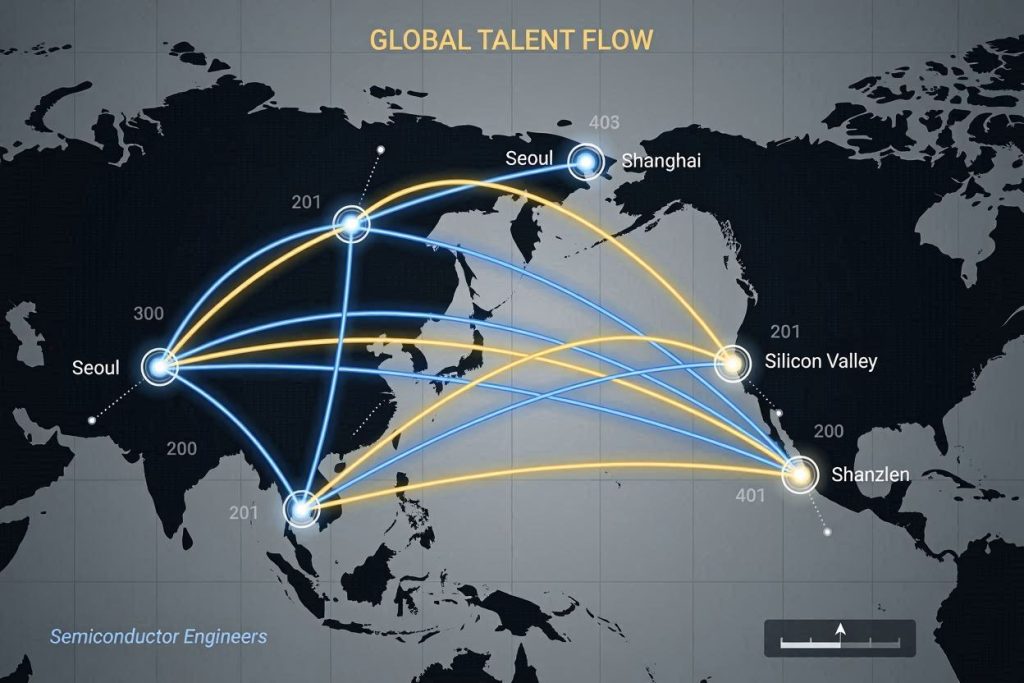
This is the real challenge for Chinese semiconductors. You may not be able to hire Samsung’s people. But you have already made them aware of your existence. When global compensation data is visible on LinkedIn and Chinese companies become “frequently mentioned” rather than “dismissed,” talent flow shifts from one-way loss to price discovery. Samsung’s massive bonuses are, in part, a response to Chinese competition — a message to employees: “Don’t leave. The outside is not as good as it seems.”
The supply-demand math does not favor the buyers.
In Q1 2026, global semiconductor job postings rose 47% year-over-year. AI chip positions alone grew 112%. The supply of qualified candidates grew just 18%. McKinsey estimates that by 2027, the global AI chip talent gap will reach 120,000 to 150,000 people — with China accounting for roughly one-third.
This gap cannot be filled by throwing money at it. A competitive DRAM design engineer requires five to seven years of industry experience. An advanced packaging expert needs over a decade. Samsung’s leadership in HBM (high-bandwidth memory) is built on ten years of deep DRAM accumulation. Chinese companies can buy equipment, IP licenses, and design tools. They cannot buy ten years of experience.
Three strategies for Chinese chip companies
Short-term: Pay the premium, buy the time. Several top-tier Chinese chip companies have adopted “no cap” compensation for critical roles. An HBM packaging expert who was earning 1.8 million RMB at SK Hynix’s Shanghai R&D center was signed by a Shenzhen company for 2.8 million RMB plus 3 million in equity — a 1.5x premium. The logic is not “we have money to burn.” It is “one key person can save two years of R&D time.” In the AI chip race, every quarter of lead time can translate into hundreds of millions in orders. This logic is gaining boardroom acceptance. Headhunters report that “mega-recruit” mandates (total package over 3 million RMB) in China’s AI chip sector tripled year-over-year in H1 2026.
Medium-term: Build a domestic talent pipeline. The poaching premium is unsustainable. Samsung’s $416,000 bonus is funded by 10.5% of operating profit — higher profits mean higher bonuses. Most Chinese AI chip companies are not yet profitable. Paying top dollar for talent is essentially venture capital subsidizing compensation. When funding tightens, the subsidy ends.
The real solution is closing the loop from university to industry. China’s microelectronics programs expanded dramatically from 2022 to 2025 — undergraduate programs grew from under 30 to over 110. The problem is where graduates go. Most choose internet companies (starting pay: 300,000-400,000 RMB) over chip design (starting pay: 180,000-250,000 RMB). The talent pricing mechanism does not favor hardware. Reversing this flow requires not one company’s compensation adjustment, but a revaluation of the entire industry chain.
Long-term: Redefine the compensation benchmark. Sun Tzu China advised one AI chip startup not to try matching Samsung or Nvidia — you will never win that game. Instead, create a domestic substitute for the “Samsung bonus formula”: link equity grants to company milestones, so employees feel they are sharing in industry growth, not just collecting a paycheck.
The company adopted a “dual-engine compensation model”: base pay at domestic P50 level, plus a “milestone option pool” — each time the company hits a technology target (tape-out success, yield rate achievement, customer qualification), every employee unlocks options. When the company successfully mass-produced its first AI inference chip in 2025, the total option unlock reached 120 million RMB. For a 240-person company, that is 500,000 RMB per person — not Samsung’s $416,000, but industry-leading by Chinese standards.
The underlying principle is simple: you do not need to be richer than Samsung. You need to make your people believe they are not working for a survival-mode company, but participating in an industry-defining adventure. Samsung’s $416,000 buys more than loyalty. It buys belief that the company will keep sharing the upside. If Chinese chip companies can build the same trust mechanism, even at a fraction of the absolute value, they can retain core teams.
The Samsung-union agreement is, on the surface, a labor negotiation result. Underneath, it is a marker of talent pricing regime change. When the world’s most profitable memory chip company allocates 10.5% of operating profit to frontline workers, the signal is not “the chip industry is rich.” The signal is “too few people can do this work.” Scarcity sets the price, not cost.
For Chinese semiconductor executives, the lesson is not a compensation benchmark. It is a timeline. Samsung can pay $416,000 to keep its people. Your engineers are watching their market value rise every quarter. By the time they discover their market price has exceeded your budget ceiling, it will already be too late to adjust.